
The Migrant Ministry: Light, Love, and Accompaniment
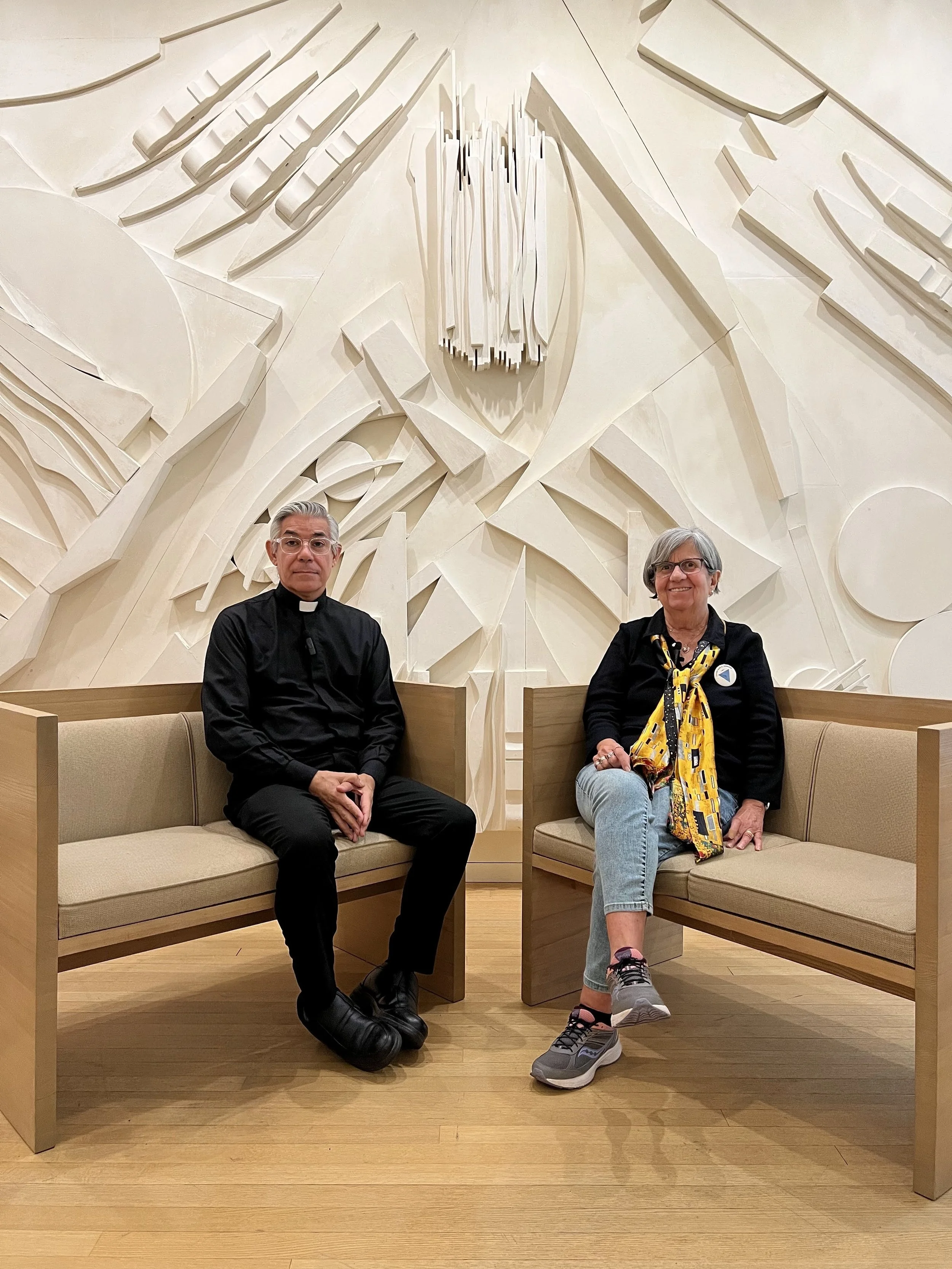
The Rev. Eduardo Fabián Arias and Marisa García, a ministry volunteer, reflect on God’s call for Saint Peter’s Church to walk alongside and embrace the migrant community in New York.
A PERSONAL AND COMMUNAL CALL
How did you begin getting involved in migrant ministry?
EFA: My name is Eduardo Fabián Arias, and I am one of the pastors here at Saint Peter’s Church. This was also the parish that welcomed me 23 years ago as an immigrant and as a member. For me, this is a call from God that grew out of my own experience as a migrant. When I arrived in 2002, I needed a place of support, listening, and welcome. Being an immigrant means being stripped of and uprooted from your most important relationships. Being received, embraced, and accompanied by Saint Peter’s felt incredibly beautiful to me. That experience shaped the kind of ministry I wanted to pursue: working with the migrant community of New York.
MG: My husband David and I moved to New York in 2012, and we came to Saint Peter’s because my husband’s great-grandparents were baptized here. Within less than a year, we became members. We heard about a meeting focused on immigrants and got excited—this was exactly what we wanted to do. Originally, my father in Argentina involved me in activism, especially during the military dictatorship of the 1970s. Here at Saint Peter’s, Father Fabián inspired us because we are Latino, we are Argentine. One case that deeply impacted me was that of a member from Nigeria. The entire community supported him—we attended his immigration hearings and celebrated when he was granted asylum. Today, he is a school principal.
THE WORK OF THE MIGRANT MINISTRY
How would you describe the work you do?
EFA: I believe it is the guiding star—the star of God that leads us forward. Without these forms of support, we would be like the three wise men who lost their way. It is that light that calls us to care for one another as sons and daughters of God. God wants us to love and protect each other, not to generate hatred and violence.
MG: We are part of a volunteer group called Acompañamientos (Accompaniments). Father Fabián receives constant calls from people in desperate situations, sometimes while they are standing in line to enter the courts. He contacts us, and we go to immigration court with them. Our role is presence. Even when we wait for hours, the person feels supported and accompanied. Now, with the presence of masked ICE agents creating fear, our act of walking alongside them is vital.
It is terrifying for us, and we cannot imagine what it is like for them. It’s important for people at Saint Peter’s to know that most volunteers do not speak Spanish, but we use Google Translate. This creates a meaningful opportunity for members who don’t speak Spanish to get involved. It’s simply about being with someone—it’s about community.
EFA: I want to emphasize that this is a ministry that cannot possibly be carried by just two people. There are countless individuals and organizations involved. In addition to court accompaniment, we also offer:
Sunday Legal Clinics: Attorneys volunteer their time—often for 12 or 13 years—choosing this work instead of being home with their families. More than 3,500 people have met with lawyers over the past three or four years.
Assistance and Referrals: We provide letters of support for court cases, employment, and medical services, as well as assistance with food and clothing.
Unaccompanied Minors: We have helped more than 228 young people obtain documentation so they can work and live with dignity and equality.
Medical and Social Support: We accompany families to hospitals and schools, especially those who do not speak English and are afraid to access services.
Food Distribution: Every Thursday, food is distributed at shelters where residents are not allowed to cook.
A Network of Solidarity: We collaborate with organizations such as the Metropolitan New York Synod, the Sanctuary Movement, Make the Road, Legal Aid, Catholic Charities, Bronx Defenders, and The Door.
What makes the difference is that Saint Peter’s is not just a nonprofit organization providing services. It is a family; it is a home, where people come to be heard, loved, and embraced.
THE POWER OF FAITH AND TRANSFORMATION
What transformation have you seen in the people you accompany?
MG: The impact is seeing the fear at the beginning—especially now, with all this terror—and then, when everything goes well, witnessing a complete transformation in just a few hours. We go to a café, take a photo, and send it to Fabián so he can see the smile of happiness. That is the value of walking alongside them. For me, the faith of migrants is admirable—the faith to say, “God first,” despite everything they have endured. They have suffered immensely in their home countries through threats, torture, and domestic violence, and then along the journey, crossing the unimaginable with children.
EFA: They are my greatest teachers. The best sermons I have ever heard come from migrants—their testimonies of the drama and tragedy they have lived. When you hear that they have crossed jungles and rivers and say, “If God had not been with us, we would not be here,” it stays with you. I have been to the Darién Gap, and I thought, “I couldn’t even walk one kilometer of what these people endure.” It is a life lesson—it is God present among us, the God who accompanied the people in the Exodus.
LOOKING AHEAD
What hopes do you have for the future of the ministry?
EFA: That we continue walking together in hope, because hope always opens new horizons and new paths. That we keep building chains stronger than those of hatred and death, because the way forward is love, the way forward is God, and it is about continuing to build together a society of peace, love, and justice. I believe we are all guardians of one another, and we must take on that responsibility as God’s family—to care for and protect one another.
MG: My hope is that people stop seeing undocumented immigrants as foreigners, because all of us have been immigrants at some point. That they see the immigrant and say, “This person is just like me.” We must continue walking alongside them.