
A Theology of Accompaniment
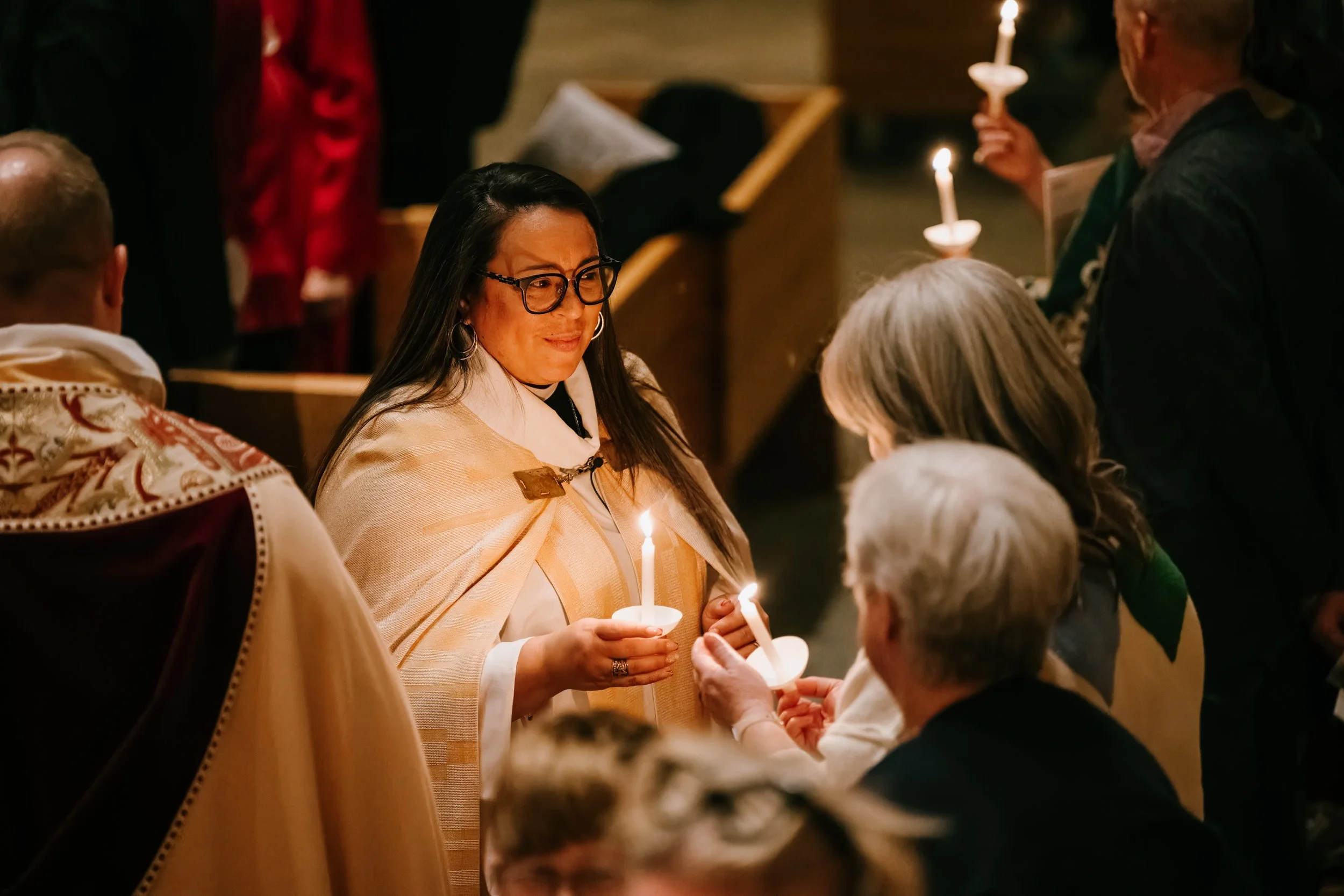
(Fadi Kheir)
On a dusty road to Emmaus, two disciples walked alongside a stranger, sharing their grief, their confusion, their shattered hopes. They didn't know it yet, but this stranger was Jesus, the risen Christ walking with them in their darkest hour. 'Their eyes kept them from recognizing him,' the text tells us. But he didn't abandon them in their blindness. Instead, he joined their journey, listened to their pain, and walked with them until their hearts began to burn with recognition and hope.
This ancient story pulses at the heart of what we do at Saint Peter's Church, particularly in our immigration ministry. It reveals a theology of accompaniment, a way of being present with others that mirrors how God is present with us. It's not about having all the answers or fixing everything quickly. It's about walking together, listening deeply, and trusting that Christ is present in the journey itself.
When Eyes Cannot Yet See
Think about those disciples on the Emmaus road. They had witnessed unimaginable trauma. Their beloved teacher: the one they had loved, followed, and cherished had been beaten, mocked, and crucified. Hope itself had been nailed to a cross. What they had seen with their physical eyes would have discouraged anyone. The grief and trauma had shaped what they could and couldn't see. Their expectations had narrowed their vision.
How often do our immigrant neighbors walk this same road? They flee violence, persecution, economic devastation. They journey thousands of miles carrying children, carrying dreams, carrying the weight of hoping for something better. They arrive in New York exhausted, traumatized, often unable to recognize the possibilities before them because of what they've endured. Their eyes, like those disciples, are kept from seeing clearly. Not because they lack faith or courage, but because resurrection is hard to perceive when you're still carrying the weight of crucifixion.
As a Sanctuary Congregation, Saint Peter's we seek to understands this deeply. We don't always get it right, but we make sure not to rush people through their grief or their legal processes. We especially don't demand that they immediately 'adjust' or 'integrate' or prove their worthiness. Instead, we walk alongside them. We offer legal services and the ministry of presence. We sit and grieve with families navigating impossible systems. We learn names, stories, dreams. We recognize that what looks like 'just paperwork' to some is actually about human dignity, family unity, and the possibility of hope after trauma.
The ELCA Vision: Mission as Walking Together
The Evangelical Lutheran Church in America has embraced the Emmaus Road as our foundational story for mission and ministry. We describe mission not as going to 'help' people, but as accompaniment, a journey of mutuality and interdependence. It's an ongoing relationship of walking together, not a project with an endpoint.
In the Emmaus story, Jesus doesn't impose himself on the disciples. He joins their path. He walks at their pace. He listens before he speaks. He waits for an invitation before entering their home. This is the model we're called to embody in our immigration ministry.
We thank God for what we’ve learned from Pr. David, who works with Spanish-speaking immigrant children and families, and Vicar Deivis, who himself migrated from the Dominican Republic and understand accompaniment intimately. They know what it means to navigate faith journeys in a new country, to hold onto hope when systems seem designed to crush it, to find beauty in the midst of displacement. Their ministry isn't about being 'experts' who fix others' problems; it's about walking together, sharing the road, trusting that Christ walks with us all.
Pastor Arias's own story embodies this theology. When he arrived from Argentina in the 1990s, he and the people of Saint Peter's accompanied one another through the immigration process, through seminary, through ordination. Along the way, there was mutual learning, challenges, and abundant grace. When economic crisis forced Iglesia de Sion into diaspora, we walked together into an unknown future until we found a new home. Accompaniment meant bearing witness to each other's struggles, celebrating each other's resilience, and trusting that God was present in the journey.
'We Had Hoped': And Hope Still Lives
'We had hoped,' the disciples said to the stranger on the road—one of the most heartbreaking phrases in all of Scripture. We had hoped he would be the one to redeem Israel. We had hoped our future would look different. We had hoped...
Our immigrant neighbors know this lament intimately. We had hoped the asylum process would be faster. We had hoped our children wouldn't have to grow up in fear. We had hoped we could work legally, live without hiding, reunite our families. We had hoped...
And yet, and this is the gospel truth, Jesus meets us precisely in these moments of dashed hopes. He doesn't wait for perfect faith or clear vision. He joins us on the road while we're still walking away from Jerusalem, still struggling to believe the testimony of resurrection, still full of anxiety about tomorrow.
This is what our immigration ministry proclaims: We are not alone on this road. Christ walks with us, often disguised in the faces of volunteers who help with legal paperwork, in the community members who practice English and learn Spanish with you, as a congregation that says 'you belong here' when the government says otherwise. Together, we understand these as sacramental acts of accompaniment, tangible ways we embody Christ's presence for one another as we journey through fear toward hope.
Hearts That Burn Before Eyes Can See
Something remarkable happens in the Emmaus story. Before the disciples recognize Jesus with their eyes, their hearts begin to burn. There's recognition happening at a deeper level—a warmth, an urgency, a sense that something profoundly important is taking place.
This is the mystery we witness in immigration ministry. Long before legal status is resolved, before paperwork is complete, before outcomes are certain, hearts begin to burn. A mother's heart burns when she realizes someone will advocate for her family. A father's heart burns when he can finally tell his story and someone believes him. A child's heart burns when they discover a community that sees them as beloved, not 'illegal.'
And our hearts burn too. We, the so-called 'helpers,' are transformed by accompaniment. We learn languages we didn't know, taste foods we'd never tried, hear stories that shatter our assumptions about borders and belonging. We discover that Christ has been walking with us all along, teaching us through our immigrant neighbors what it means to hope against hope, to love fiercely in the face of systems designed to separate, to recognize God's image in every face regardless of documentation status.
Breaking Bread, Opening Eyes
Full recognition came to the disciples only in the breaking of bread. When Jesus took bread, blessed it, broke it, and gave it to them. In that familiar gesture of hospitality and communion their eyes were opened. They recognized him. And immediately, he vanished from their sight.
At Saint Peter's, we gather around Word and Sacrament with people from countless nations and languages. We break bread together, literally in our community meals, spiritually in Holy Communion. In these moments, eyes are opened. We recognize Christ in each other. We see that the 'stranger' we welcomed was actually Christ himself: 'I was a stranger and you welcomed me.'
This is why our immigration ministry isn't a side project or optional program. It's central to who we are as the body of Christ. Every time we accompany someone through the asylum process, every time we provide sanctuary, every time we advocate for just immigration policies, every time we simply sit and listen to someone's story, we're participating in the pattern Jesus established on the Emmaus road.
The Call to Accompany
The Emmaus story doesn't end with recognition. It ends with mission. The disciples immediately got up that same hour, despite the late evening and their tired feet and returned to Jerusalem. They couldn't keep this joy to themselves. They had to share what they had experienced.
This is our call, too. Once we've experienced accompaniment; once we've walked with Christ on the road, once our hearts have burned with recognition, once our eyes have been opened at the table, we can't stay still. We must return to the world and share this good news: The Lord has risen indeed! Love is stronger than fear! God's welcome is wider than any border!
The work isn't easy. Accompaniment never is. It requires patience when legal processes drag on for years. It demands hope when deportation threats loom. It asks us to resist the urgency of 'fixing' and instead embrace the long obedience of walking together. It calls us to see Christ in faces that our society has taught us to fear or ignore.
But here's what we discover on this road: Jesus meets us exactly where we are. He joins our journey. He listens to our confusion about immigration policy and our anxiety about doing the 'right thing.' He walks with us through our own uncertainty and our limited understanding. And gradually, if we're paying attention, our hearts begin to burn. We start to recognize him in the stranger we're walking beside. Our eyes are opened at the table we share.
We learn that accompaniment is mutual. We're not the saviors walking alongside the saved. We're all disciples on the Emmaus road, all struggling to recognize resurrection, all learning to see Christ in each other. The immigrant family we accompany through the asylum process accompanies us toward deeper faith. The undocumented worker we protect in sanctuary teaches us about courage. The child we help enroll in school shows us what it means to hope.
This is the beautiful, transformative truth of accompaniment theology: We become God's presence to one another through 'telling stories, sharing resources, seeing each other as valuable and valued.' We walk together not because we have everything figured out, but because Christ has called us to the road, and we trust that he walks with us.
An Invitation
So here's the invitation: Join us on the Emmaus road. Walk alongside your immigrant neighbors. Support the ministry that embodies Christ's presence with the most vulnerable. Give generously so that legal services can continue. Volunteer your time to accompany families through complex systems. Advocate for policies that reflect God's radical welcome. Learn names, share meals, listen to stories.
Don't be surprised when you can't immediately see Christ in the work. The disciples walked seven miles before their eyes were opened. Don't assume that your doubts or questions disqualify you from this ministry. Jesus walks with questioners and doubters too. Don't believe the lie that only 'experts' can do this work. Accompaniment requires only a willingness to walk beside someone, to listen deeply, and to trust that Christ is present in the journey.
Our prayer is simple: Open our eyes. Burn our hearts. Help us recognize Jesus in the stranger, the immigrant, the refugee, the asylum seeker. Give us the courage to walk together even when the road is long and the outcome uncertain. Teach us that accompaniment isn't futile but the very pattern of how God loves the world.
And then, when our eyes are opened, when we recognize Christ in each other, give us the urgent joy to get up and share this good news: The Lord has risen indeed! Love is stronger than borders! God's table has room for everyone! We are all beloved children making our way home, and Christ walks with us every step of the journey.
May you know Christ's presence on the road you're walking today. And may you recognize him in the face of the stranger walking beside you.